

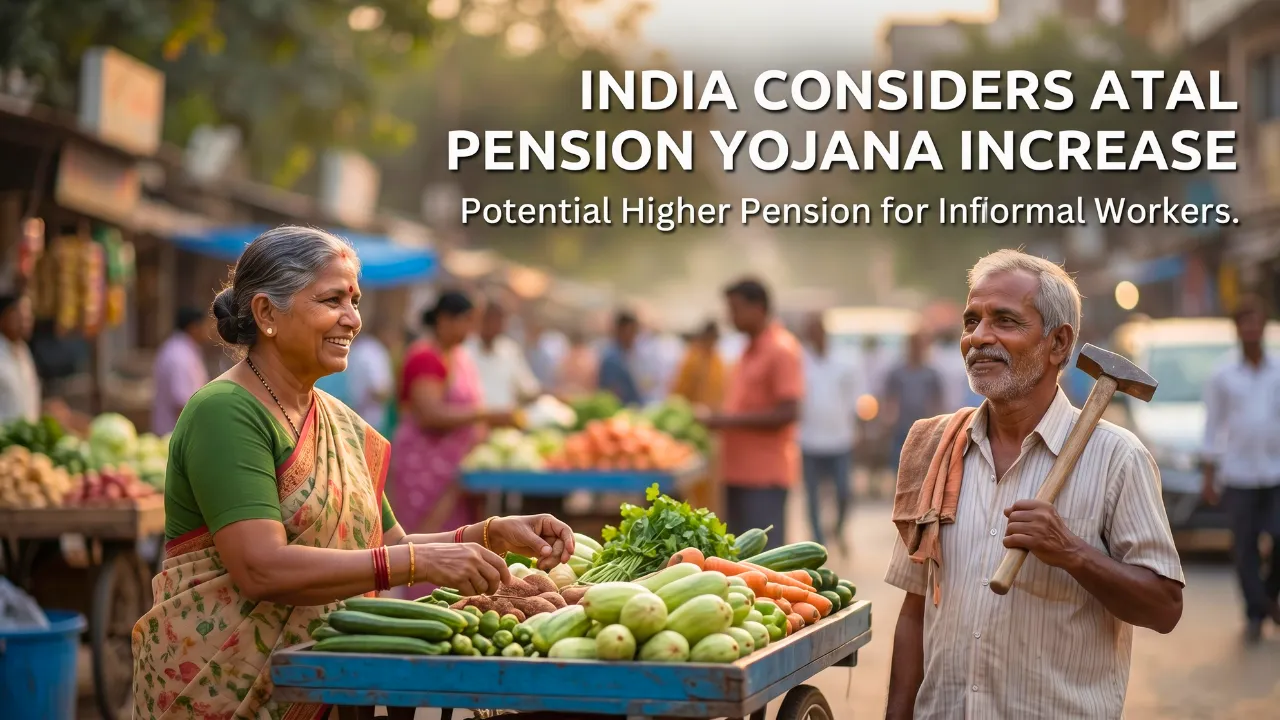
The Indian government is planning to expand social security coverage for informal workers. In response to rising inflation and increasing expenses for retirees, the government is considering raising the upper limit of the minimum pension under the Atal Pension Yojana (APY) to ₹10,000 per month. Three officials spoke to Mint on condition of anonymity.
Informal workers in India are those in the unorganised sector who lack job security, a fixed salary, or social security (PF, pension, leave). They constitute approximately 90% of the country’s total workforce, including street vendors, domestic workers, labourers, and the self-employed.
Why is this change necessary?
The Atal Pension Yojana was launched in May 2015. Its main objective is to provide financial support to unorganised-sector workers, farmers, shopkeepers, and small businesspeople in their old age. Currently, this scheme provides a guaranteed pension of ₹1,000 to ₹5,000 per month after the age of 60. However, due to rising prices, this amount is falling short.
What is the current situation?
More than 90 million members have joined the Atal Pension Yojana so far, but nearly half have stopped making regular contributions. The highest number of new members so far, 13.5 million, joined in the financial year 2025-26. The government believes that increasing the pension limit will encourage new members to join and retain existing members.
What is the new proposal?
The Ministry of Finance and the Pension Fund Regulatory and Development Authority (PFRDA) are working together on this proposal. The upper pension limit is likely to be increased from ₹8,000 to ₹10,000 per month. An official said, “This change will make the scheme more attractive and adapt it to the rising cost of living.”
How much government contribution?
Members who joined before March 31, 2016, received a government co-contribution for the first five years. This amount was 50% of the member’s contribution (maximum ₹1,000 per year). This benefit was available only to those who did not pay income tax and were not enrolled in any other social security scheme.
How will the scheme be expanded?
The government plans to reach the scheme in every village through ‘Pension Sakhi’ and Business Correspondents (BCs). The challenge of continued contributions is also being addressed. On January 26, 2026, the Cabinet approved continuing the scheme until the financial year 2031. Support for promotional, development, and gap-funding activities will also continue.
Will this be a burden on the government treasury?
Experts say this change will not put much pressure on the government treasury, as the Atal Pension Yojana (APY) is largely run on members’ own contributions. Vivek Iyer of Grant Thornton says, “APY is a defined-contribution scheme. Security is its primary objective. Therefore, this change will not put any significant financial pressure on the government.”