

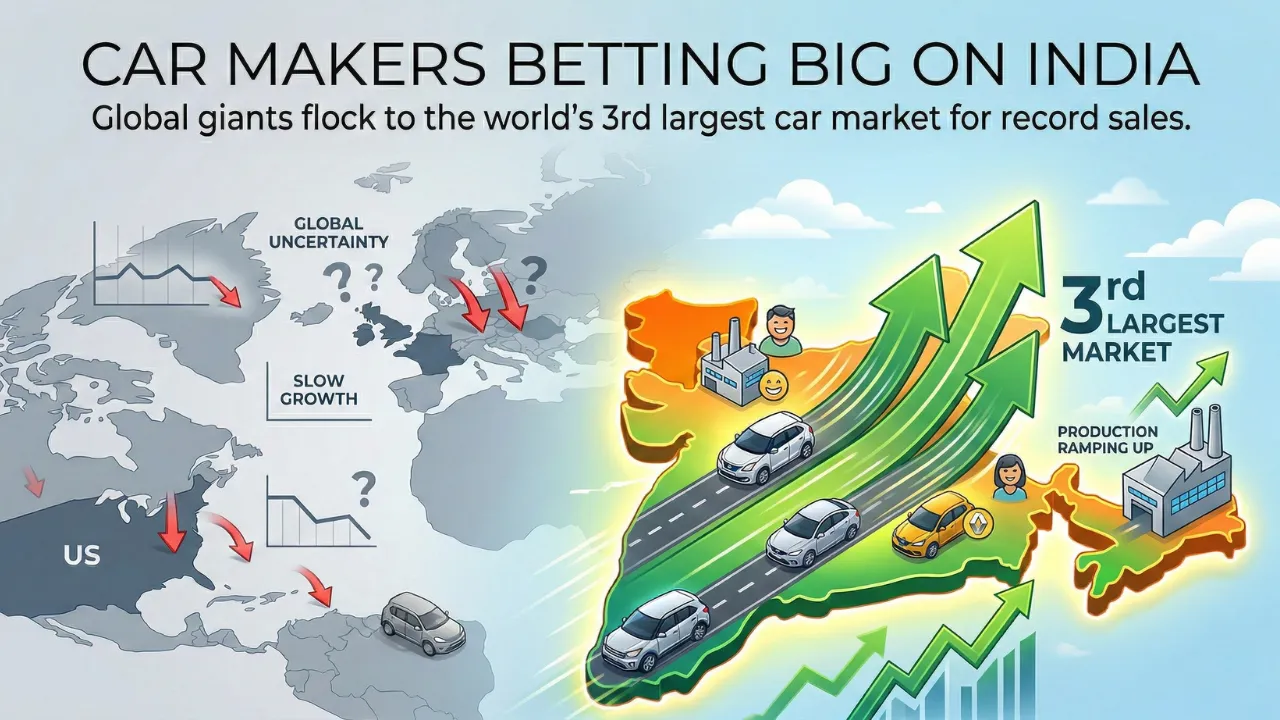
The world’s two largest carmakers are betting big on growing sales in India amid global geopolitical uncertainties. Japanese automaker Suzuki Motor Corp recently raised its production forecast for the current fiscal year to 3.52 million units, hoping to boost sales in India, its largest market, following last September’s GST rate change.
South Korea’s Hyundai Motor estimates that its sales growth in the Indian subcontinent will be the fastest globally in 2026. These Asian automakers, along with their European competitors such as Renault and the Volkswagen Group, are excited about the opportunities in India, which is now the world’s third-largest market with significant growth potential and serves as a manufacturing hub for exports. Let’s explore the companies’ projections.
Hyundai is also seeing growth.
Hyundai, which expects global sales to rise a modest 0.5 percent to 4.16 million units this calendar year, estimates 3.1 percent growth in India. In a recent presentation to investors, it projected sales growth of 0.5 percent in the US, 1.8 percent in Korea, and flat sales in Europe. For Hyundai, India is its third-largest market outside its home base, after the US and Europe, accounting for approximately 14 percent of international sales. Hyundai Motor India’s sales in January were the highest on record.
Managing Director Tarun Garg said in a recent conversation, “If January is any indication, I think we are poised for a very strong run.” Citing growing expertise and strong local demand from both urban and rural markets, he said many companies are reporting strong growth. “We are seeing such positive momentum after a long time.”
What is Suzuki’s planning?
Of the 67,000-unit production increase Suzuki estimates for this quarter, 92.5% will be in Asia, where its Indian subsidiary Maruti Suzuki operates four factories with a total annual capacity of 2.6 million units. This country accounts for 56% of Suzuki’s global sales and approximately 65% of its production. Partho Banerjee, Senior Executive Officer (Marketing and Sales) at Indian market leader Maruti Suzuki, said that sales of all models in the portfolio have increased following the GST cut.
He added that demand is so high that the company’s production teams are working overtime. “In January alone, we operated our plants on two Sundays and the Vasant Panchami holiday.” Banerjee added that rate cuts by the Reserve Bank of India have made car loans cheaper, and the income tax reset announced in last year’s budget is also boosting demand.
Suzuki’s sales in India grew 3.8 percent to 1.35 million units in the first nine months of this fiscal year, while in Europe they declined 18 percent to 135,000 units. Sales in Asia, excluding India and AMEO/LatAm (Africa, Middle East, Oceania, and Latin America), grew rapidly, but on a low base. In addition to India and Japan, Suzuki also has facilities in Thailand, which it agreed to sell to Ford in January, and in Vietnam.
Estimates from Other Foreign Companies
Among other foreign automakers, Renault, which acquired a 51 percent stake in its India manufacturing unit from alliance partner Nissan, has stated that India is a “key pillar” of its global growth plans. CEO Fabrice Cambolive recently told ET that the company expects 50 percent of its growth over the next three years to come from the Indian and Brazilian markets. Cambolive said the company is looking to launch several new products, including several SUVs, to increase its sales share in the Indian market to 3-5 percent by the end of this decade.