
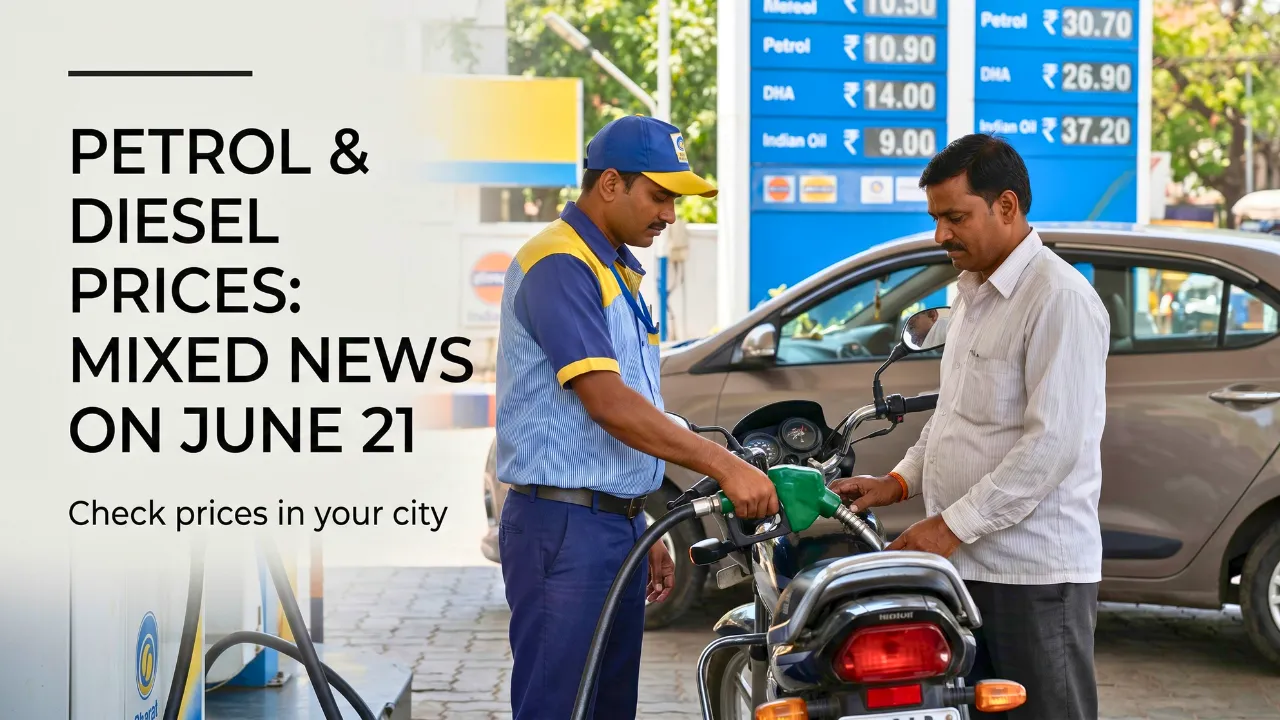
Petrol Diesel Price Today: The 21st of the month has arrived. If you’re planning to drive your car to the petrol pump today, first understand the math behind the oil prices. Oil marketing companies have released new petrol and diesel rates for today. Today has been a mixed day for consumers.
In some states, the common man has received some relief from inflation, while in others, the burden on their pockets has increased slightly. Meanwhile, in many major cities, including Delhi, petrol and diesel prices have remained unchanged. Let’s find out how much you’ll pay for a litre of oil in your city today.
Peace in Delhi-Bengaluru, prices reduced in Chennai-Mumbai.
For customers in Delhi, Kolkata, Gurugram, and Bengaluru, there are no new surprises today. Oil companies have made no price changes in these cities. Residents of Delhi can still fill up on petrol at ₹98.64 per litre, while diesel remains stable at ₹91.58. Similarly, petrol is selling for ₹109.70 per litre in Kolkata, ₹99.38 in Gurugram, and ₹107.16 in Bengaluru.
However, if you live in Chennai, Jaipur, or Patna, there’s good news for you. In Chennai, petrol has fallen by 35 paise to ₹104.57, while diesel has become cheaper by 33 paise. In Jaipur, petrol has fallen by 30 paise to ₹108.70.
In the financial capital, Mumbai, petrol prices have fallen marginally by 4 paise, while diesel remains stable at ₹94.08. People in Patna, Lucknow, Chandigarh, and Hyderabad have also benefited from today’s partial price drop.
Customer tensions rise from Noida to Thiruvananthapuram.
While prices have fallen in some cities, oil has become more expensive in Noida, adjacent to Delhi. In Noida, petrol rose by 19 paise to ₹98.65, while diesel also rose by 19 paise to ₹91.93 per litre. In Bhubaneswar, petrol rose by 21 paise to ₹105.33. In South India, petrol in Thiruvananthapuram rose by 18 paise to ₹111.71, while diesel jumped by 29 paise to ₹100.59.
In fact, the difference in fuel prices across states in the country is entirely due to taxation. The price of crude oil in the international market, the value of the rupee against the dollar, the central government’s excise duty, and state governments’ own value-added tax (VAT) are factors that contribute to different oil prices across cities.
Crude oil prices rise, eyes fixed on US deal.
Now the question arises: what is happening internationally? Crude oil prices in the global market have again risen slightly today. Brent crude oil is trading above $105 per barrel, recovering from its previous 5.6% drop.
Meanwhile, the US benchmark WTI is hovering around $99. Market analysts believe this rise followed US President Donald Trump’s claim that negotiations with Iran were in the final stages. This raised hopes for improved global supply. However, crude oil prices have risen by more than 40% since the end of February.
Losses to companies, burden on the general public
Despite the continuously rising cost of crude oil, the direct impact on the general public in India has been minimised. Public sector oil companies bore the burden of rising costs for 76 days. This resulted in a massive under-recovery loss of ₹24,500 crore. Following this, the companies have increased prices by a total of ₹3.91 per litre in two instalments.
At the same time, the central government has also tried to control prices by reducing excise duty. The government treasury has suffered a loss of approximately ₹30,000 crore due to the reduction in excise duty. Companies have suffered a further loss of ₹40,000 crore due to stagnant domestic gas (LPG) prices.
Compared to other countries, petrol has become 45% more expensive in the US. In Myanmar, Malaysia, and the UAE, prices have risen by more than 50%. In India, the increase has been limited to just 4.4%, the lowest among major economies.