

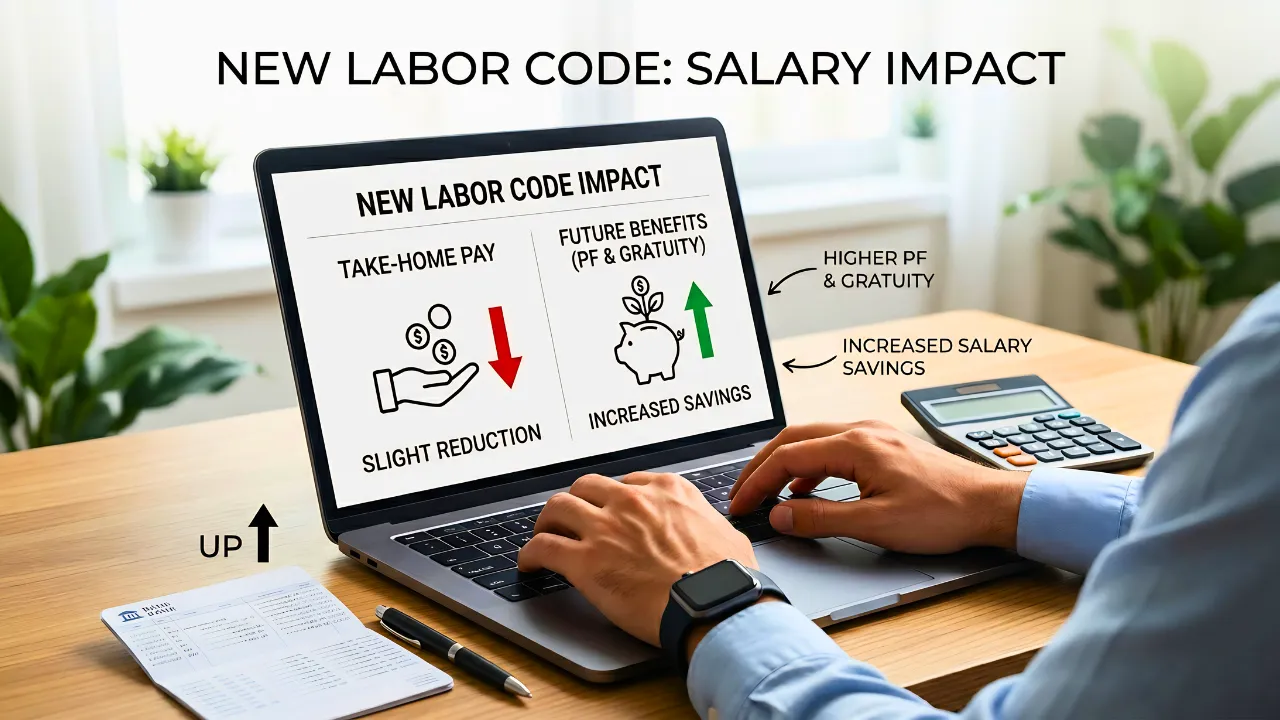
If your take-home pay has decreased slightly this month, you’re not alone. Many employees are experiencing similar pay cuts. Companies are now trying to explain why this is happening due to the new labour code.
What’s the reason?
According to ET, this salary reduction is due to structural changes. Employees’ Provident Fund (PF) contributions have increased because they are now calculated on the higher basic salary (12% of the basic salary). Similarly, the gratuity deposit amount has increased and is now linked to the higher basic salary.
What’s the impact?
Vikram Shroff of AZB & Partners says that, according to the new labour code, at least 50% of your total pay package (CTC) should be considered as wages, regardless of how your company previously distributed your salary. He said that in cases where the basic salary was low, companies have increased it by 50% to comply with the new rules. This has reduced other components of the salary, but increased the PF contribution. This is why the net salary received has decreased.
What is the change?
Employees are now clearly seeing this change in their salaries. IT professional Deepak C. said that the gratuity component of his salary has now doubled. His annual CTC has increased by ₹90,000, but ₹40,000 of that is going towards gratuity. Previously, it was only ₹20,000. He said his actual increase is effectively ₹50,000, divided between PF and other components.
Shock or benefit?
50% rule: An employee’s basic salary must be at least half of his CTC. The increase in basic salary has increased the share of PF and gratuity, reducing the monthly amount received. With more money deposited in gratuity and PF, the amount received at retirement will be significantly larger.
What do experts say?
EY India Partner Puneet Gupta explained that previously, gratuity was calculated only on basic salary and dearness allowance. Under the new labour code, it is linked to the definition of wages in the Special Security Code 2020. This will increase the basis for calculating gratuity, and the amount received upon leaving the job or retiring will be significantly higher.