
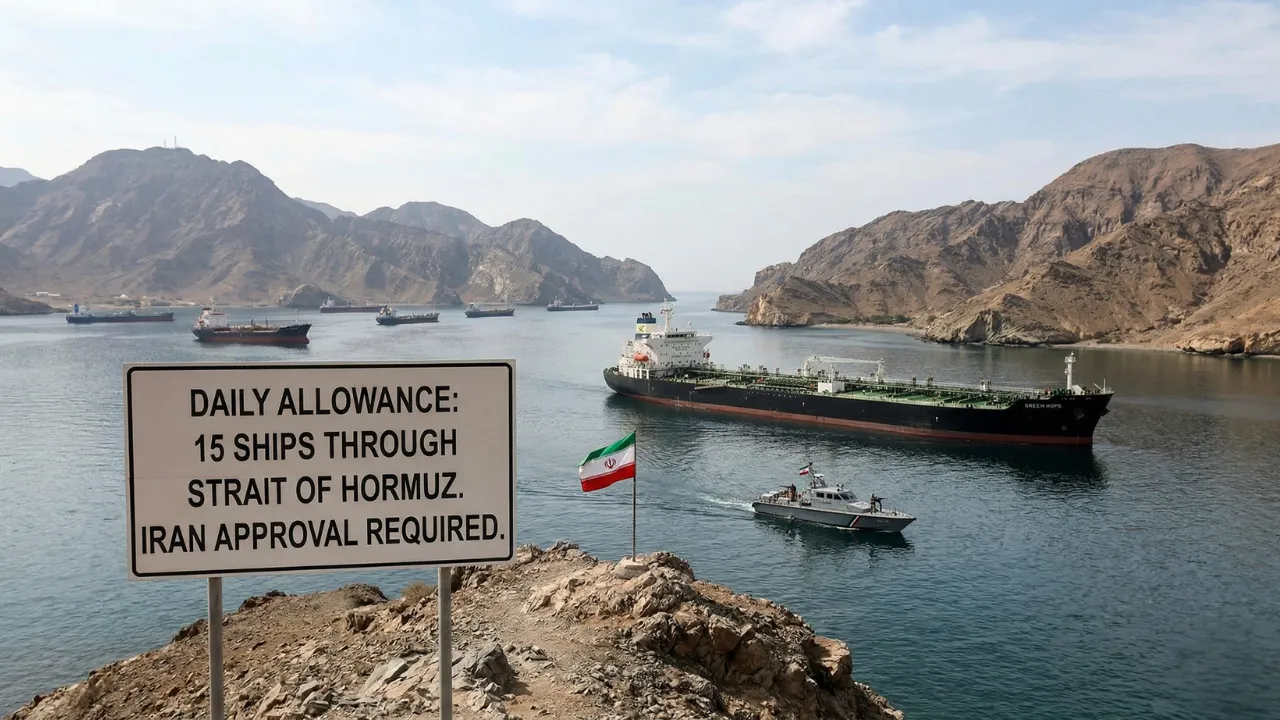
Only 15 ships will be allowed to pass through the Strait of Hormuz each day. These ships will need Iran’s approval to pass through. Russian news agency TASS reported this information, citing senior Iranian sources, ahead of the talks in Islamabad. Recently, an Indian-flagged oil tanker, the “Green Hope,” crossed the Strait of Hormuz. The vessel, carrying 15,400 tons of LPG, arrived at the Jawaharlal Nehru Port Authority in Navi Mumbai. It is being reported that 15 Indian ships are now stranded in the Strait of Hormuz.
The source stated that under the terms of the ceasefire, Iran will not allow more than 15 ships to pass through the Strait of Hormuz each day. Shipping through this waterway remained virtually halted on Thursday.
Fees will also be charged!
According to media reports, Iran and Oman will now charge fees from ships transiting the Strait. While this has not been officially stated, Iranian officials have hinted at it amid the war. Significantly, ships previously did not need to pay a fee to pass through this area. It is being said that Iran will use the proceeds for reconstruction work.
Agreement with Conditions
Amid the ceasefire in the Middle East between the US and Iran, Tehran has made it clear that this agreement comes with conditions. Iran says that it will take a long time for shipping through the Strait of Hormuz to return to its pre-war status.
These conditions include requiring Iran’s prior permission for each vessel to pass through. Ships will have to follow a specific protocol. The Revolutionary Guard will supervise the new regulatory framework. According to an Iranian source, there will be no return to the pre-war status quo. It should be noted that approximately one-fifth of the world’s seaborne crude oil trade passes through this Strait.
One tanker passed in the last 24 hours.
According to a Reuters report, one oil tanker and five different dry bulk carriers passed through the Strait of Hormuz in the last 24 hours on Thursday. Two Iranian-flagged tankers also passed through Hormuz.
Demand for the release of frozen assets within two weeks
Iran has also attached a financial condition to the ceasefire. Tehran demands that its frozen assets abroad be released before the two-week ceasefire period expires. The source said, “Unfreezing Iranian assets is an important operational guarantee that must be met within this deadline.”
Tehran is also insisting that the end of the war be formally recognised on its own terms through a UN Security Council resolution. Iran has warned that if the end of the war is not included in a Security Council resolution based on its conditions, it is fully prepared to resume war against the US and Israel.
Condition of no increase in the number of US troops
Iran has also demanded that Washington not increase its military presence in the region during the two-week ceasefire. On the issue of uranium enrichment, the Iranian source said they were committed to the text of the agreement exchanged.